

How to Find an Electrician Near Me
Electricians are licensed professionals with the knowledge and experience to safely and efficiently perform electrical work safely and efficiently. They're frequently needed to help with urgent repairs or renovations. They can also assist you in finding ways to improve the efficiency of electricity in your home.
An electrician should be contacted when a homeowner experiences an increase in their electric bills month after month. They might be able to identify inefficient appliances or old wiring that is causing excessive energy usage.
Wiring
Wires are a vital part of any electrical system. Without them, electricity won't be able travel anywhere. They are employed for a variety of reasons, including powering outlets and switches, feeding fuses, or running hundreds of kilometers of transmission lines.
Insulated wires are a great option to keep away electric fires and shocks. Insulated wires can also help save money on energy bills. To determine the amount of insulation you require take a look at the square footage of your house or building.
To determine this, you will have to think about the size of your doors and windows. Once you know the total size of your house, multiply it by the R-value for the insulation material that you plan to purchase.
It is also crucial to determine the amount of insulation is needed to complete your project. This will ensure your home or building is comfortable all year round and will help you save money on heating and cooling.
It's a good idea for someone to assist you in case you don't have much experience in wiring. These professionals can ensure that the wiring you have in your home is safe and reliable.
If it isn't done correctly, wiring is a critical component of any electrical installation. You and your family members are at risk if there isn't have proper wiring installed in your home.
The first step in wiring is to create an outline of your wiring project. electrician near me free estimate will allow your electrician to find areas that require more attention and help them find the problem faster. It will also save you time and money in the long run , by avoiding unnecessary rework or additional expenses.
Switches
The flow of current in an electric circuit is controlled by switches. They can cut off or restore power if needed. There are two kinds of switches that are operated manually and those which can be controlled by process variables such as flow, temperature, current, and pressure.
Typically switches have two conductors (called poles or throws) that are connected to complete the circuit. They then break off to interrupt it. This is done by inserting an extremely high resistance (air gap) in the circuit to stop current flow, and by eliminating the resistance to begin it over.
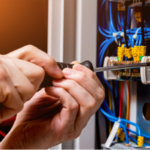
The contact materials are selected to minimize the formation of insulating oxides that could inhibit the switch's function. Aluminum is a very popular contact material, due to its resistance to corrosion and high electrical conductivity.
A ball tilt switch, which has a metal liquid contact like mercury, is a very common type of switch. When the bulb is tilted, this liquid metal rolls onto the contacts to create the connection.
Another type of switch consists of mercury droplets inside an glass bulb that is tilted to connect the contacts. This type of switch is more efficient than the ball tilt switch as it lubricates the contacts and blocks them from forming insulating substances which could affect the switch's operation.
Safety switches can also be used in commercial and residential structures as circuit breakers to safeguard people from electric shock and fire. They can also be used to signal to a device, for instance an opener for garage doors.
Lighting
Lighting can be a difficult job that should only be performed by licensed electricians. You require someone who is able to safely and correctly replace a fixture that is old.
The right light can enhance the look of your office or home and function, as well as make the space feel more comfortable. The most popular kinds of lighting are ceiling mount fixtures.
A lighting expert can assist you choose the ideal light for your space as well as your budget, and the best way to install it. They'll also make sure the lighting is installed in a safe manner and correctly according to local codes.
They'll have to know the height of your ceiling as well as the kind of light fixture you are planning to install. They'll calculate the size and location for the light fixture in order to maximize space and stop the room from feeling cramped.
They'll also have to figure out where the most direct sunlight will fall. This is vital for optimizing your energy efficiency and reducing the cost of electricity.
They'll also need to consider how much heat they will radiate. This is a complicated decision which will consider several factors like the insulation of your home, the type of lighting and the proximity your fixture is to the source of heat source.
The lighting industry has lot to offer with regard to the latest LED bulbs to advanced dimming and sensor systems that control lighting remotely. If you are committed to your work, you are able to earn certifications, such as the Lighting Certification Examination (LCM) which is a test of basic lighting design concepts.
Alarms
Alarms are an essential part of any home security system. They help keep your property secure by alerting you to potential dangers and threats such as burglary, fire and gas leaks.
An alarm sends an alert to a central monitoring station via an internet connection or a phone network. The monitoring station will verify that the alert is legitimate and dispatch emergency assistance if required.
There are numerous kinds of alarms, and it is important to choose the best one to meet your needs. They include flood sensors smoke and heat detectors as well as carbon monoxide detectors.
These are usually connected to the control panel. They can be activated by opening a door, movement in the home, or by an alarm that makes a loud sound. They can be installed for the entire home or even zoned so that you can choose which rooms are monitored.
If you are in the market for a new alarm, make certain to select one that is simple to install and compatible with your security system. It's also a good idea to search for an alarm that isn't just affordable but has a long warranty period and is backed by a reliable service provider.
An experienced electrician should conduct wiring. It is the process of ensuring that all appliances are connected and that the correct conduit is placed around the building. This will prevent any electrocution or fire.
Another crucial component of any wiring is the insulation. Insulation is an essential component of any wiring. It helps to stop fire from spreading. It can be constructed from a variety materials, including plastic fibres, natural fibres, and mineral (rock or slag) wool.
Fault Finding
Fault finding is a technique to identify the root cause of an electrical malfunction. It is usually a process that involves a number of steps. The first step is to determine the source of the issue. This process can be done with a variety of test instruments and tools.
For example, a multimeter could be used to measure the levels of voltages and currents. It can also be used to determine the resistance of wires and cables.
Another instrument is a fault-finder , which is used to detect and locate faults on cables, pipes and other equipment. It operates by sending a energy pulse through insulation and locating the resulting trace.
The trace that is produced by a fault-finder is typically similar to the trace that a cable would produce if it is perfectly insulated. The cable might produce an unintendedly different trace in the event that it isn't properly sealed.
Once the fault is located then a cable tracer can be used to pinpoint its exact whereabouts. These two-piece devices use both a receiver and transmitter to put a high-frequency tracing tone on the cable.
After the tracing tone has been transmitted, the operator walks the cable that holds the transmitter and receiver. As they walk, the device audio and visually indicates the strength of the signal.
Fault-Find direction arrows will latch onto the signal and will point forward when they are near the fault. The arrow will then flicker, and the dB readings increase as the A frame moves closer to the fault. As the Arrow moves away from fault, the readings of dB will decrease.
If the readings of dB are too low to pinpoint the problem, continue taking readings at shorter intervals until you can pinpoint the issue.